A few months ago, a parent I was counseling described a situation I’ve heard countless times before. Her teenage son had suddenly become overly protective of his phone. The screen was always locked, and his chat history? It disappeared instantly. From time to time, new apps would appear and vanish just as quickly.
At first, she thought it was just typical teenage privacy. Fair enough—teenagers should have their own space. But over time, these subtle changes began to bother her.
This tension—the conflict between protecting your child and respecting their privacy—is something I encounter constantly in my work as a data privacy consultant. And it almost always leads to the same question:
When does digital surveillance cross the line into unethical surveillance?
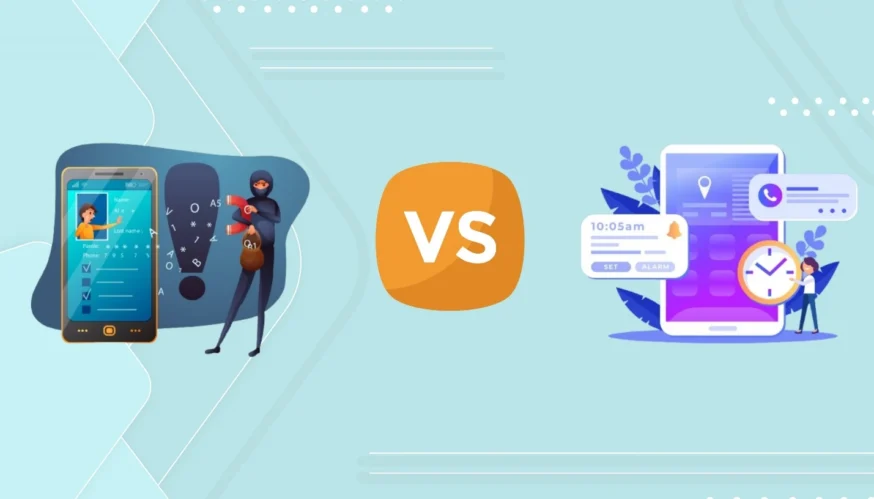
To answer this question, you need to clearly understand the difference between stalker software and legitimate phone monitoring apps, and I’m here to help.
⚠️ What is spyware, and why is it so dangerous?
Let me be blunt: stalkerware is software designed for covert surveillance that is installed on a device without the owner’s knowledge or consent. There is no transparency whatsoever, and no one gives consent for its use. Moreover, it serves no legitimate security purpose. Its entire value lies in its invisibility.
Over the years, I have analyzed dozens of stalker software variants as part of my assessment of mobile threats. Once installed, these tools can operate undetected:
- Track a person’s location at any time, even if they don’t open the map
- Intercept private text messages and call recordings to gain insight into their personal interactions and steal their personal data
- Secretly activate the microphone or camera to record what is happening around the device
- Access personal photos, saved files, and browsing history to steal data
- Create a detailed behavioral profile based on the app’s usage, all while the victim remains unaware that they are being monitored
And the scale of this problem is greater than most people realize, which is precisely why the use of spyware has increased by 51%. This figure alone should be enough to make anyone pause and consider just how “normal” covert surveillance of devices has become.
In addition to obvious privacy violations, stalkerware poses a second, often overlooked risk: data security. During audits I’ve participated in, we’ve discovered stalkerware products running on poorly secured servers where sensitive data was stored in plain text, without proper encryption or access controls.
The data collected by these programs is not only accessible to the attacker; it can also end up in the hands of third parties. In several documented cases, compromised servers hosting stalking software have exposed victims’ data publicly on the internet. A recent data breach compromised the personal information of 2 million users.
⚖️ What makes a monitoring app legitimate?
This is where, in my opinion, many people get confused.
A legitimate phone monitoring app does not hide from the person being monitored. This is the clearest distinction I can point out after ten years of working in this field. Everything else—features, capabilities, collected data, and so on—may look almost identical to stalker software. The ethical line is drawn not by what the tool does, but by how and why it is used.
Over the past five years, I have evaluated several parental monitoring platforms as part of privacy compliance audits. The best of them are built on three essential principles:
- Transparency – the child or device user is aware that monitoring is taking place. There are no hidden icons, secret settings, or deception.
- Consent and communication – monitoring is part of a clear family agreement. It was discussed, explained, and agreed upon, rather than imposed without discussion.
- A safety-focused initiative—the goal is to identify real risks: cyberbullying, online predators, the impact of harmful content, or excessive screen time, which affects sleep and mental health.
This last point is important because the risks parents are trying to manage are very real; in fact, about 61% of parents report that they monitor the websites their teenagers visit. However, visibility alone is not enough, as many of them still find it difficult to strike a balance between supervision and independence.
In fact, the challenge lies in knowing how to manage the situation responsibly and respond appropriately.
✅ Ethical monitoring – choosing the right option
When families start exploring their options, one name that comes up quite often is Xnspy. I want to address this specifically because tools like this illustrate a key point I keep coming back to: technology itself is neutral. Its ethical implications depend entirely on how it is used.
When I evaluate a parental monitoring platform professionally, I focus on three things:
- Data visibility and control – can parents see what data has been collected, and can it be deleted?
- Security Practices – How Is Data Stored, Transmitted, and Protected?
- Target structure – Is the product designed for overt surveillance or covert surveillance?
Most popular phone monitoring apps, including widely discussed ones such as Xnspy, fall under the category of parental control when used as intended. Their feature set includes:
- Call log tracking – view incoming and outgoing calls to flag unknown contacts
- App Activity Monitoring – See which apps are being used and how often
- GPS tracking – confirm that your child has arrived safely at school or at a friend’s house
- On-screen analytics – see what’s actually displayed on the device in real time
- Timely alerts – alerts regarding specific predefined actions to enable timely intervention
I’ve seen firsthand how these phone monitoring capabilities can really make a difference. In one case I consulted on, a parent noticed unusual patterns of late-night messaging through the Xnspy monitoring dashboard and uncovered a cyberbullying situation within days, rather than weeks or months, as might otherwise have been the case. Such early detection has real implications for a child’s well-being.
That said, let me be frank and honest about this: I recommend using tools like Xnspy only when they are used transparently. The child should know that monitoring is taking place. It is important for parents to convey to them that the tool is used to identify safety risks, not for control or punishment. In general, parents should understand and comply with local privacy and surveillance laws before installing Xnspy.
When these conditions are met, the Xnspy phone monitoring app becomes a tool for parents. When they aren’t, unfortunately, it can turn into stalker software, regardless of the brand name on the box.
🧠 How does context change everything?
One of the most important things I try to help parents understand is that almost every feature found in stalker software also exists in monitoring tools. It’s not the features that determine ethics, but the context.
Let me summarize my experience so you can see how it varies from feature to feature.
📍 GPS tracking
- Legitimate use – confirmation that a 13-year-old child has safely arrived at an after-school event.
- The use of stalker software—secretly tracking a partner’s movements without their knowledge.
💬 Message monitoring
- Lawful use – detecting attempts at cyberbullying or grooming by strangers.
- Using spyware to read a partner’s private conversations in order to control them.
📱 App Monitoring
- Parental controls – managing screen time and identifying apps that expose children to harmful content.
- The use of stalker software—monitoring a user’s device activity without their consent or knowledge.
In cybersecurity, we sometimes refer to this as the dual-use classification problem. The same tool can serve entirely different purposes depending on the context and intent behind its use.
❓ Frequently Asked Questions: The 3 Most Frequently Asked Questions
Is it legal to install monitoring software on someone else’s phone?
Legality depends entirely on your jurisdiction. In many countries, installing monitoring software on another person’s device without their consent violates privacy or wiretapping laws. Parents monitoring their minor children generally have broader legal options, but regional laws vary significantly. Always consult local regulations before installing any monitoring software.
Can parental monitoring apps become stalking software?
Yes, and that’s an important point. A legitimate monitoring app can become stalkerware if it’s used secretly, without consent, or for the purpose of surveillance rather than security. The classification depends on how the tool is used, not on what it’s capable of.
How can parents monitor their child’s phone in an ethical way?
Ethical monitoring starts with an honest conversation. Tell your child about the monitoring, explain its purpose, and work together to clearly define expectations. Gradually reduce supervision as your child demonstrates responsibility. The goal is always safety and guidance, not constant surveillance.
👤 Author’s Biography
Mark Stephen, Cybersecurity
Expert and Data Privacy Consultant
Mark Steven is a cybersecurity expert and data privacy consultant with over 10 years of experience in digital security, threat analysis, and privacy compliance. He holds key industry certifications, including CISSP, CISM, CEH, and CIPP. His work focuses on assessing how digital systems handle sensitive information, particularly in mobile and cloud environments. He has specific expertise in parental monitoring programs, where he evaluates security practices, data handling, and regulatory compliance.